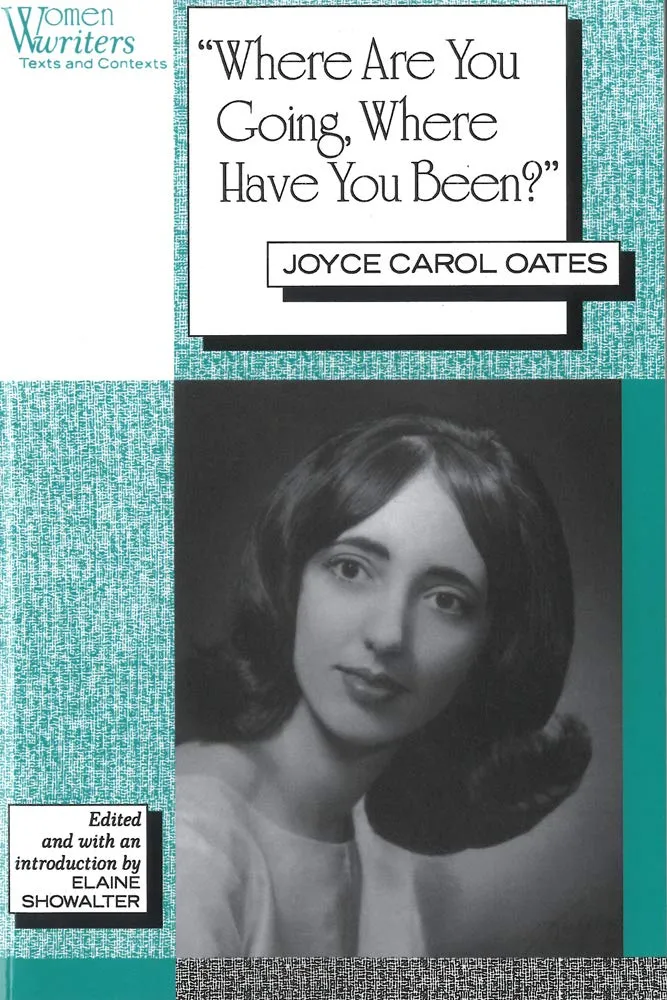
Where Are You Going, Where Have You Been? (1966)
by Joyce Carol Oates
Rutgers University Press,ISBN 978-0813521350
Wife suggested this as another must-read on the heels of the last must-read by this up and coming author named Flannery O’Connor. I noted then that O’Connor showed “good, intriguing promise as a writer.”
This Oates gal is no different. I’d say she demonstrates exceedingly high competence and promise with words and images and flow.
Spoilers to follow.
This is as powerfully horrifying a fucking story as the last one. I might ask my wife to suggest some some buoyant material the next time. Same feeling where I sat up straight, read incredulously, got swept up into this delirium where my head screamed “Noooooo!”, and read it at least twice to figure out the horror of what had happened first and what it was all about next.
There is a lot of interpretation and commentary and even a movie (starring Laura Dern, fittingly called Smooth Talk). I was very surprised to see a dedication to Bob Dylan. And Oates herself thought that “Death and the Maiden” was “rather too explicit”:
Oates said that she dedicated the story to Bob Dylan because she was inspired to write it after listening to his song “It’s All Over Now, Baby Blue”. The story was originally named “Death and the Maiden”.
In subsequent drafts the story changed its tone, its focus, its language, its title. It became “Where Are You Going, Where Have You Been?” Written at a time when the author was intrigued by the music of Bob Dylan, particularly the hauntingly elegiac song “It’s All Over Now, Baby Blue,” it was dedicated to Bob Dylan.
“Where Are You Going, Where Have You Been?” and Smooth Talk: Short Story Into Film, Celestial Timepiece, cached
The Antagonist
This is at least based on Charles Schmid, AKA the Pied Piper of Tucson, a notorious serial killer from the 60’s.
Schmid was called the “Pied Piper” because he was charismatic and had many friends in Tucson’s teenaged community. For a time, the members of his teenage coterie would keep the secrets of his murders […] He spent part of his time on Tucson’s Speedway Boulevard, picking up girls and drinking with friends, although he tended to be a loner. […] Schmid was a short man who wore cowboy boots stuffed with newspapers and flattened cans to make him appear taller; he explained to impressionable teenagers his resultant rolling gait was a result of a “crippling fight” with Mafia members. He used lip balm, pancake makeup and created an artificial mole on his cheek. Schmid also stretched his lower lip with a clothespin to make it resemble Elvis Presley’s.
So there’s that.
But then the interpretation and symbolism and ‘mythology’ goes to bizarre and truly fascinating places.
He’s Satan: cloven-hooved, weird gait, needs to support himself. He knows things he cannot possibly know. Connie knows there’s something seriously amiss but cannot help being curious and cannot help being powerless. The license plate on his jalopy is 33 19 17. Judges 19:17 is where the title of the story comes from. The sum 33 + 19 + 17 is 69 which would be of deep interest to Oates’ sparring partner on Twitter. Should’ve worked a 420 in there to get him to actually read her work. I’ve read about how “An Old Friend” is to be read as “An Old Fiend.”
Or maybe he’s Pan (he says the place she came from doesn’t exist any longer, and where she had intended to go is also no longer an option) or the Big Bad Wolf (says he can easily destroy her house/haven.) Most likely Satan though. There’s also some gemmatria.
WTF Happened?
No idea and I don’t think I can think about this more, really. It’s graphic without being graphic. The wailing, sweat, resignation, surrender, Connie’s sacrifice and violation, and sheer sinisterness in the last few paragraphs are experiences I won’t ever forget. Consider:
“My sweet little blue-eyed girl,” he said in a half-sung sigh that had nothing to do with her brown eyes but was taken up just the same by the vast sunlit reaches of the land behind him and on all sides of him—so much land that Connie had never seen before and did not recognize except to know that she was going to it.
Jesus. I think I’ll just settle with what Oates said about her work:
It was cast in a mode of fiction to which I am still partial—indeed, every third or fourth story of mine is probably in this mode – “realistic allegory,” it might be called. It is Hawthornean, romantic, shading into parable.
I’ll work with my wife to read some ‘Hawthornean’ things next. Here’s a short film adaptation on Vimeo.